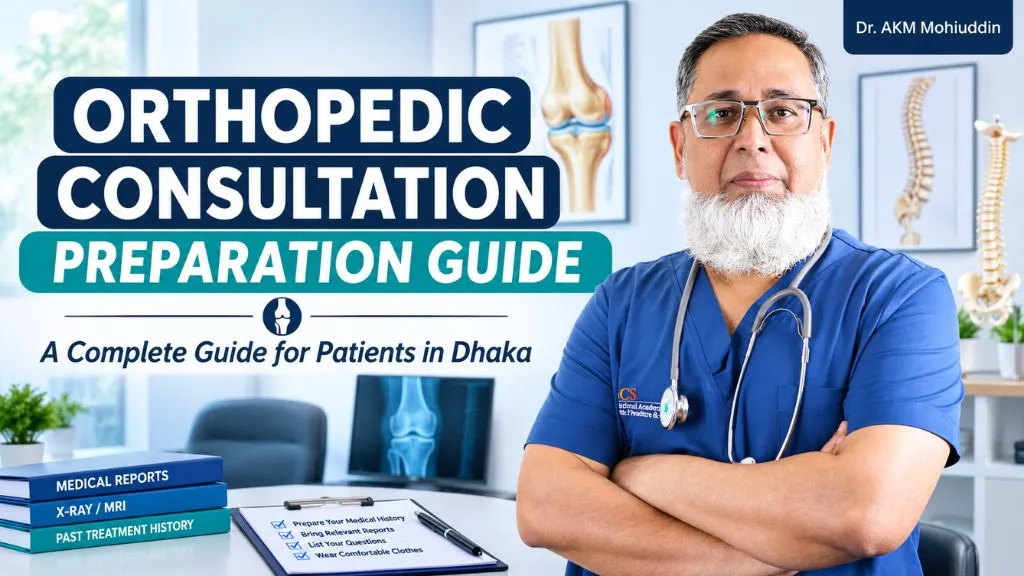
Your knee has ached on the stairs for three months. Or your lower back stiffens every morning and takes an hour to loosen. You have finally booked an appointment with an orthopedic specialist, and now a practical question comes up: what should you bring, and what should you say once you are in the room?
Good orthopedic consultation preparation takes about half an hour at home. It can save you a repeat visit, an unnecessary test, or a treatment decision made on incomplete information.
Why Preparation Matters Before an Orthopedic Consultation
Most orthopedic diagnoses begin with conversation, not machines. How your pain started, what makes it worse, and how it has changed over time often point toward a diagnosis before any scan is reviewed.
For some common conditions, history and examination are enough. UK guidance from NICE recommends diagnosing osteoarthritis clinically, without imaging, in people aged 45 or over who have activity-related joint pain and little or no morning stiffness.
Previous investigations still matter. They show how a condition has progressed, and they can sometimes spare you a repeat test. The American Academy of Orthopaedic Surgeons (AAOS) notes that when your surgeon can review results you already have, new tests may not be needed, depending on how recent they are and how complex your condition is.
Medical Documents and Reports You Should Bring
Gather everything related to the problem, even if it seems old, and keep it in one folder in date order.
X-ray, MRI, and CT Scan Reports, With the Images
Bring your X-ray and MRI reports along with the actual images. A report is a radiologist’s summary; the images let your doctor see the bone, joint, or soft tissue directly.
Diagnostic centres in Bangladesh usually provide X-ray films, and MRI or CT images on a disc or online portal. Carry films flat, bring the disc, and keep any portal login handy.
AAOS advises patients not to rely on the imaging facility to send scans on their behalf, since delays can hold up care.
Blood Tests and Other Investigations
Bring recent blood reports, especially any ordered for the same complaint. Nerve conduction studies and bone density reports are worth including too, if you have had them.
Prescriptions, Discharge Summaries, and Surgical Records
Bring previous prescriptions, any hospital discharge summary, and, if you had an operation, the operation notes and implant details.
Do You Need New Tests Before the Visit?
Usually not, unless a doctor has asked for them. Not every orthopedic problem needs an X-ray or MRI.
NICE, for example, advises against routine imaging for low back pain in non-specialist settings, and explains that people referred for a specialist opinion may not need imaging at all. Let your specialist decide which investigation, if any, will actually change your treatment.
Prepare a Clear History of Your Symptoms
Your symptom history is often the most useful thing you bring. Write it down beforehand, because details fade during a short appointment.
Try to answer these points:
- When did it start? After a fall, a twist, or a sports injury, or gradually?
- Where exactly is the pain? Point with one finger if you can.
- Is it constant, or does it come and go?
- What makes it worse? Stairs, kneeling or sitting for prayer, lifting, long bus rides?
- What eases it? Rest, heat, gentle movement, a particular position?
- Have you noticed swelling, stiffness, locking, giving way, weakness, numbness, or tingling?
- How is it affecting walking, sleep, work, and daily routines?
Specific descriptions help far more than general ones. “My knee hurts” gives little to work with. “The inside of my right knee aches after 15 minutes of walking, swells by evening, and I can no longer sit cross-legged” tells a much clearer story.
If you have already been told you have knee osteoarthritis, note how your symptoms have changed since that diagnosis.
The same approach works elsewhere. With shoulder pain, mention whether reaching overhead or behind your back is difficult, and whether pain wakes you when lying on that side.
With back pain, say whether the pain travels down a leg and how far. With difficulty walking, note how far you can go before stopping, and whether pain, weakness, or poor balance is what stops you.
Make a List of Your Current Medications and Previous Treatments
Many patients remember “a painkiller” or “a calcium tablet” but not the name or dose, and that detail can matter.
The simplest solution is to bring the medicine strips or boxes, or clear photos of them. Your list should include:
- Prescription medicines for any condition, including diabetes, blood pressure, heart disease, or thyroid problems
- Painkillers and anti-inflammatory medicines, including any bought from a pharmacy without a prescription
- Any steroid tablets or injections you have received
- Supplements, such as calcium, vitamin D, or herbal and traditional remedies
- Allergies or past reactions to any medicine
AAOS recommends listing prescriptions, over-the-counter drugs, herbal products, and vitamin supplements before an orthopedic visit.
Then list the treatments you have already tried for this problem, such as physiotherapy, braces, joint injections, or surgery. Note how well each one worked and how long any relief lasted.
Please do not stop or change a prescribed medicine before your appointment unless the prescribing doctor advises it. Bring the list and let the specialist review it.
Questions to Ask During Your Orthopedic Appointment
Write your questions down before you go. Useful questions to ask an orthopedic doctor include:
- What could be causing my symptoms?
- Do I need any additional investigations, and how would the result change my treatment?
- What treatment options are appropriate for my condition?
- Can my condition be managed without surgery?
- Which activities should I avoid, and which should I continue?
- How long might recovery take?
- When should I return for follow-up, and what signs mean I should come back sooner?
Many orthopedic problems are managed with exercise, activity changes, physiotherapy, and medication. The right plan depends on your diagnosis, so ask about the reasoning behind any recommendation.
What to Expect During an Orthopedic Consultation
A first visit usually follows a familiar pattern. Your doctor will:
- Ask about your medical history and current symptoms
- Examine the affected area where appropriate, checking movement, strength, tenderness, alignment, and how you walk
- Review previous imaging and investigation reports
- Discuss the likely diagnosis and possible next steps
The exact examination and any tests depend on your symptoms and what the doctor finds. Wear loose clothing so the knee, shoulder, or back can be examined easily.
Special Considerations for Patients Travelling to Dhaka for Treatment
Many patients travel to Dhaka from Chattogram, Sylhet, Rajshahi, Khulna, and other districts. A missing report costs more when home is a full day away.
A few practical steps help:
- Bring every relevant record, including older reports from local clinics, since they show how a condition has progressed.
- Keep digital copies. Photograph each report and prescription on your phone, and save copies to email or cloud storage in case a folder goes missing.
- Prepare a one-page timeline of when symptoms began, which doctors you saw, what tests were done, and which treatments you tried.
- Bring a family member or caregiver if walking is difficult, if you need help with stairs or transport, or if you would like someone to listen and take notes.
- Allow extra time. Dhaka traffic is unpredictable, and your doctor may recommend an investigation best done on the same trip. Avoid a same-afternoon return journey if you can.
When Should You Seek Urgent Medical Attention?
Most bone and joint problems suit a routine appointment, but some symptoms should not wait. Go to a hospital emergency department promptly if you have:
- A severe injury or suspected fracture
- A limb that looks bent or out of place after an injury
- Inability to put weight on a leg after a significant fall or injury
- A hot, swollen, painful joint, especially with fever
- New or worsening weakness, numbness, or loss of feeling in an arm or leg
- Back pain with new difficulty controlling your bladder or bowels, or numbness around the genitals or buttocks
The NHS lists sudden severe joint pain, inability to move or bear weight on the joint, hot and swollen skin, and fever as symptoms of septic arthritis that need urgent medical help. NHS spinal services describe new bladder or bowel changes alongside back or leg pain as possible signs of cauda equina syndrome, a rare spinal emergency.
For long-standing back problems without these features, our page on spine and back pain explains common causes in more detail.
Final Thoughts
You do not need medical knowledge to have a productive consultation. You need your records, a clear account of what you have been experiencing, and a few written questions.That preparation helps your doctor build an accurate picture, and helps you leave with a plan you understand. To learn more about orthopedic care in Dhaka, or to arrange an orthopedic consultation, call the hotline at 09653667777.